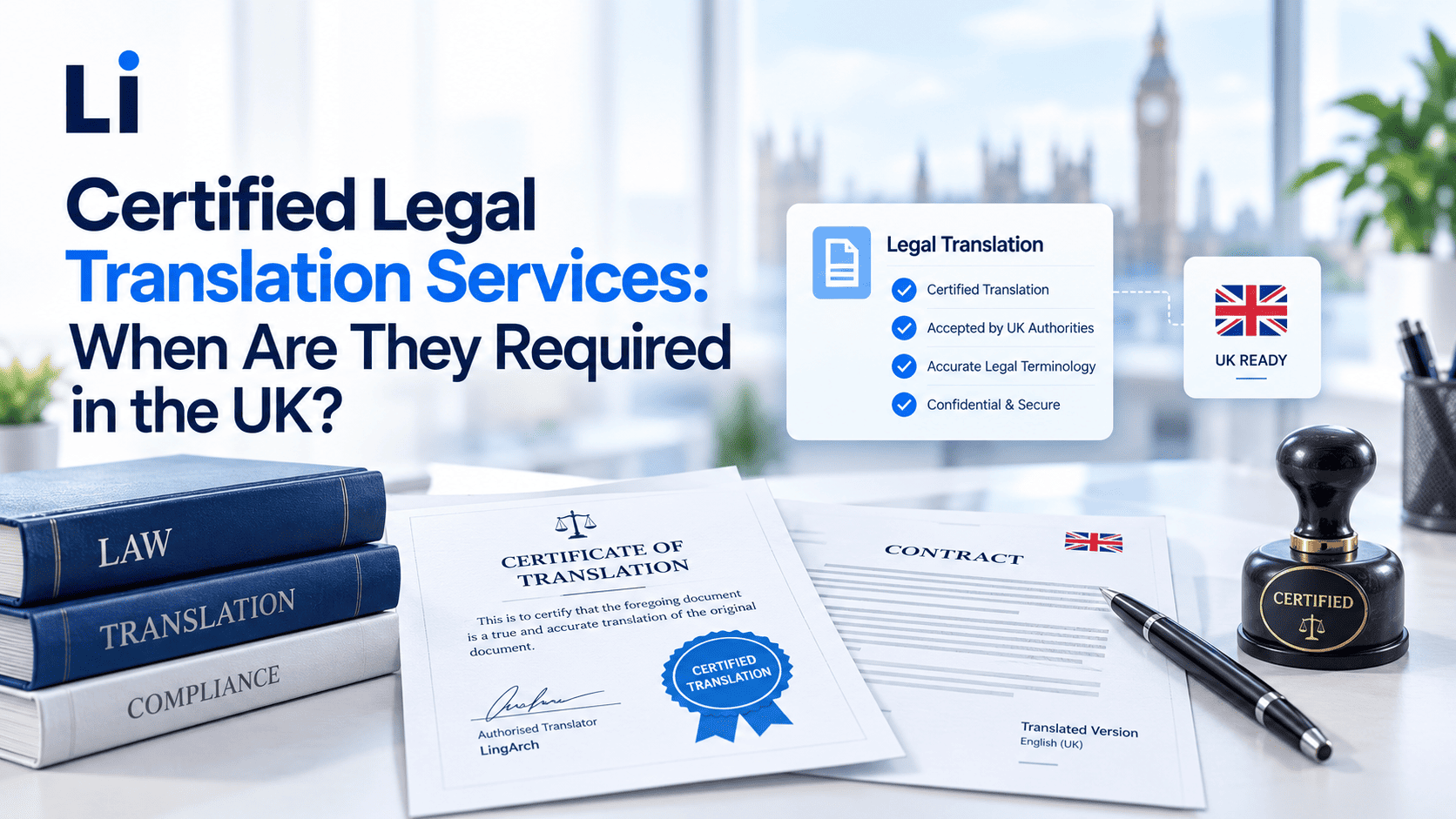
The UK handles a growing number of official documents created in languages other than English. Immigration files, court papers, academic records, contracts and professional documents may all require certified translations before an authority will accept them. In these cases, the translation has to do more than read well. It must also meet the certification rules set by the organisation receiving it.
That is why certified legal translation in the UK cannot be treated as a standard language job. The Home Office, courts, universities and regulators may ask for different declarations, signatures or supporting details. Knowing those requirements in advance helps prevent delays, rejected documents and repeat work.
What “Certified Legal Translation” Actually Means
A certified translation is more than the translated text. It comes with a signed statement confirming the work is a true and complete version of the original, with the translator or agency named. That puts a responsible party on record.
Here is the part people miss. A fluent translation can still be rejected if that statement is absent. For certified legal translation in the UK, accuracy alone may not be enough for acceptance. The body receiving it often wants a name attached as well. A translation missing this signed declaration risks immediate rejection regardless of its textual precision.
When Certification Is Actually Required
Some situations call for it far more often than others.
Government, legal and regulatory submissions may require certified translations, including immigration-related documents, court filings and professional registrations. Home Office guidance asks translations of non-English or non-Welsh documents to confirm the accuracy of the work, the date it was done, and the translator’s name, signature and contact details.
Courts are another area where certified translations may be required. Witness statements, contracts, judgments and evidence may all need legal document translation before they are accepted. Professional bodies count too, with the GMC and NMC sometimes requesting translated qualifications. Whatever the setting, official document translation should follow the exact instructions of the organisation receiving it.
Certified vs Notarised Translation: What Is the Difference?
These two get muddled often. They do separate jobs, and the organisation asking for the document decides which one applies.
| Check | Certified | Notarised |
| Main purpose | States the translation is complete and accurate. | Confirms the signature or declaration attached to it. |
| Common use | Often accepted by universities, immigration teams and regulators. | Sometimes asked for by overseas courts or authorities. |
| Extra step? | Usually none, unless the institution says otherwise. | Yes, added only when specifically required. |
Check the submission rules before ordering. LingArch provides certified translation services and can arrange Notarised translation services when an extra layer of authentication is needed.
Who Can Provide a Certified Translation in the UK
For most official processes, the work should come from a professional translator or company whose details can be verified. A certified translator should be able to provide the certification statement and supporting details required by the receiving organisation.
ISO 17100 is a well-recognised benchmark covering translation processes, resources and professional skills, though it is not a legal requirement for every UK certified translation.
Even so, a cheap quote turns expensive fast if unqualified work gets rejected and you start again.
Confidentiality and Turnaround
These documents often contain sensitive personal, legal or commercial information. Contracts, litigation bundles, immigration records and medical files often contain sensitive information. Before uploading anything, ask how files are transferred, stored and accessed.
Timing is worth pinning down too. Straightforward documents may often be completed within a short timeframe, depending on the language pair, document length and certification requirements. Larger legal sets take longer, because terminology, review and certification all have to stay consistent from one page to the next. LingArch’s document translation services cover legal, medical, financial and corporate files, with human-led review and secure handling.
A Related Example
A reputable law firm approached LingArch with an urgent requirement for legal documents to be translated for court proceedings. With a strict deadline in place, LingArch coordinated with the client to understand the requirements and allocated resources to complete the translations within the required timeframe.
The Outcome: The client received the translated documents on schedule and continued working with LingArch for future urgent legal translation requirements.
A Brief Note for Legal and Compliance Teams
For legal and compliance teams handling multiple filings, consistency across documents is as important as certification format. Working with a single translation provider can help maintain terminology accuracy, manage documentation requirements and ensure certification is applied consistently across large document sets.
Drawing on ISO 17100-aligned linguist qualification standards and experience supporting UK legal, regulatory and official document requirements, LingArch provides certified legal translation with a clear process for quality control, confidentiality and accountability.
Choosing a Provider You Can Rely On
A few checks save a lot of trouble. Confirm the provider gives a signed certification statement suited to the organisation receiving it. Ask whether notarisation can be arranged. Nail down turnaround, secure file transfer and confidentiality procedures before you send anything sensitive. For formal submissions, certified document translation should always be prepared against the authority’s stated requirements.
Conclusion: Confirm the Requirement Before Ordering
The right service depends on the document, what it is for, and the body receiving it. Sharing the full file and the authority’s instructions upfront is one of the most effective ways to reduce the risk of delays and rework. LingArch provides certified legal translation services for personal, commercial and court-related documents and helps organisations understand the certification requirements for their submissions.
Not sure whether your document needs certified or notarised translation? LingArch can help clarify the certification requirements for your document. Contact us at [email protected] or call +44 (0)208 004 7800.