One Inconsistent Term Can Disrupt an Entire Document Set
In more than two decades of managing multilingual projects, I’ve seen a single term create weeks of unnecessary rework. One department approved a product name, another translator used a literal equivalent, and the local reviewer preferred a third version. None of the translations looked obviously wrong, but together they created a confusing document set. A terminology decision can then carry across manuals, contracts, websites and customer communications. Maintaining strict translation terminology consistency requires practical controls: an approved glossary, a maintained translation memory, a style guide, clear reviewer instructions and a way to feed approved changes back into the system.
Why Inconsistent Terminology Creates More Than a Language Problem
When identical source terms receive different translations across a project, the consequences extend far beyond aesthetics. Conflicting language directly confuses customers, technical users and corporate procurement teams. For instance, if a component is labelled a “control unit” in a technical manual, a “controller” in an engineering specification and a “management module” in training materials, operational clarity can suffer. For global organisations, consistent document translation can reduce rework, delays, and avoidable confusion.
Create an Approved Multilingual Glossary Before Translation Begins
Decide Which Terms Need Control
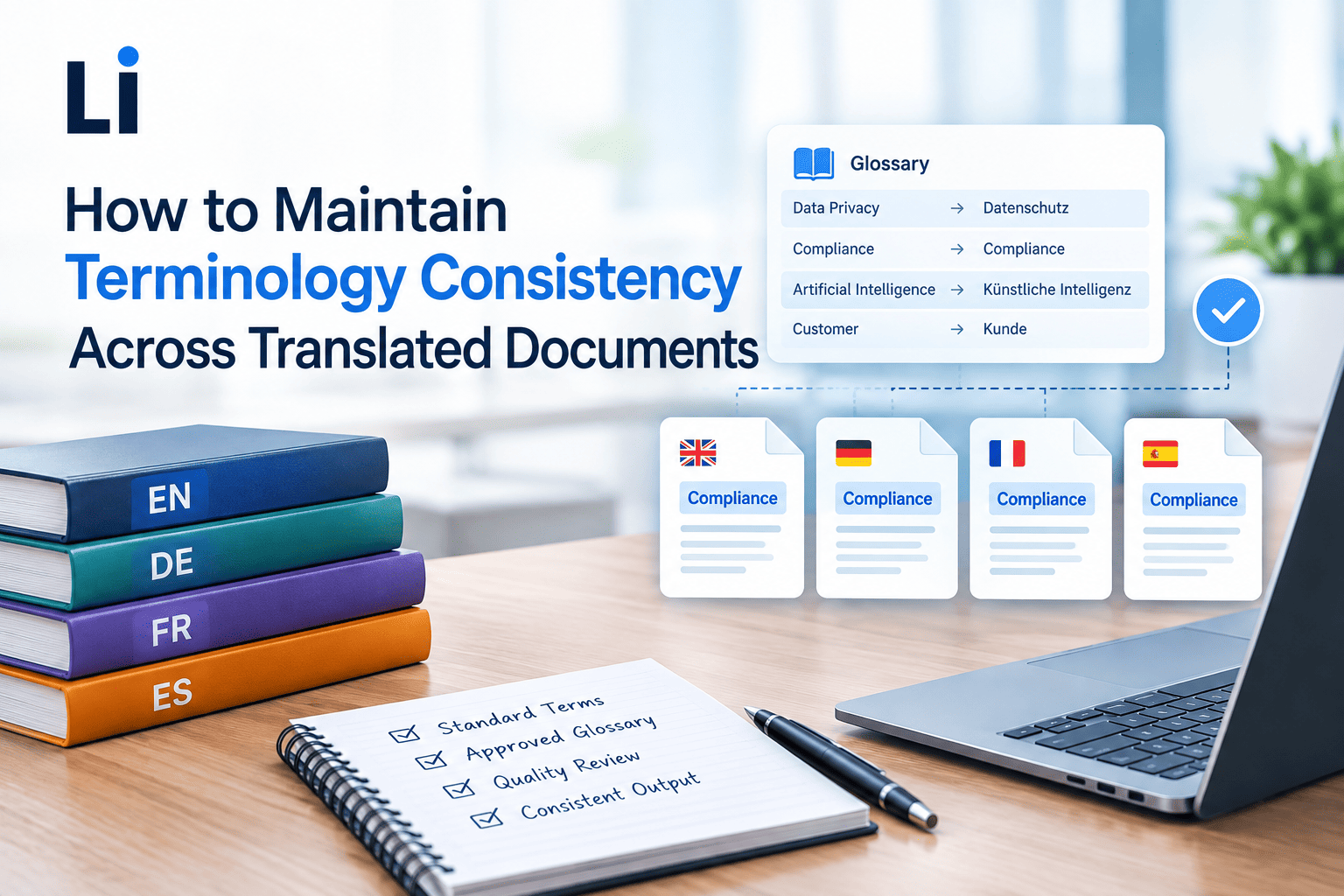
Linguistic alignment must begin before a single page is sent to an external linguist. Teams should compile a controlled terminology database containing high-risk elements such as product and service nomenclature, specialised legal expressions, acronyms and market-specific regulatory language. It is equally vital to document terms that must remain entirely in the source language, such as registered trademarks or protected brand terms. Each entry should feature brief contextual definitions so external translators understand the exact parameters of usage.
Establish an Approval Process
A multilingual glossary is only as reliable as its governance. Organisations must assign ultimate ownership of the glossary to a designated subject specialist, legal reviewer or country manager. This owner records the preferred translation, explicitly prohibits specific alternatives and notes the approval date. To prevent version control issues, teams must abandon the practice of circulating disconnected spreadsheets via email, relying instead on a centralised, master glossary.
Use Translation Memory Without Treating It as Infallible
A translation memory stores previously translated sentences, phrases and segments so they can be reused. This system is highly effective for processing standard clauses, safety disclaimers, and repetitive product descriptions.
However, technology cannot fully substitute for human governance. If outdated, unverified or poorly translated legacy content sits within the database, the system will repeatedly suggest those errors across future projects. Organisations must actively maintain their linguistic assets by segregating fully verified corporate text from legacy translations.
Control Product, Brand and Technical Language with a Style Guide
Define More Than Preferred Words
While a glossary governs individual words, a comprehensive style guide dictates the overarching corporate voice. It establishes clear rules for tone, formality levels, punctuation, date formats, numbering systems and capitalisation rules. The guide defines exactly how international teams should handle slogans, software user interfaces and corporate trademarks, allowing for natural local adaptation without diluting the core brand position.
Add Technical Context
Corporate documents often use terms whose meanings vary between departments. A style guide can provide the technical context needed to resolve these ambiguities, using reference diagrams, interface screenshots and conceptual definitions. For complex operations, the guide must explicitly differentiate between related concepts, such as “device,” “equipment,” “system” and “unit,” while enforcing market-specific regulatory terminology. This rigorous approach ensures long-term technical translation consistency.
Give Translators and Reviewers Clear Instructions
Linguistic conflict frequently arises during the internal review phase. To prevent this, project managers must issue unambiguous instructions that establish an order of priority when the glossary, translation memory and personal preference clash. Teams should implement a single, shared query log where translators can raise terminology questions and receive authoritative answers in real time.
Furthermore, local corporate reviewers must be instructed to justify their edits objectively rather than altering text based on subjective style preferences. Without clear boundaries, a common corporate mistake occurs where different regional reviewers repeatedly reverse each other’s approved changes, stalling production timelines.
Manage Versions and Feed Approved Changes Back into the System
Effective terminology management depends on strict asset maintenance and ongoing control of linguistic resources. Organisations should never permit localised copies of style guides and glossaries to sit unmanaged in regional folders or personal email threads. All linguistic resources require clear version numbering, explicit ownership tracking and documented change logs. When an internal corporate reviewer corrects a translated file, those changes must be systematically fed back into the master translation memory and glossary, helping prevent the same corrections from being repeated in future assignments.
Check Terminology Across the Complete Document Collection
Maintaining terminology consistency across large document sets requires automated quality assurance (QA) checks followed by professional human oversight. Automated tools can rapidly scan thousands of words to flag prohibited variants, structural inconsistencies or capitalisation errors.
However, because context can occasionally justify variations in prose, human editors must evaluate these automated flags. Quality teams should conduct systematic audits across all interrelated materials, ensuring that approved terminology is applied consistently across websites, contracts, software and training materials before publication.
How LingArch Helps Maintain Terminology Across Languages
For organisations looking for document translation services UK businesses can rely on, terminology controls are an important part of the workflow. LingArch supports 120+ languages through a network of 1,500+ linguistic partners, combining centralised asset management with specialist human review. LingArch references key international quality benchmarks, including ISO 17100 for translation services, ISO 9001 for quality management and ISO/IEC 27001 for information security. Standards such as ISO 20771 for legal translation and ISO 18587 for full human post-editing also apply to relevant specialist projects.
Terminology Consistency for Personal Document Sets
Linguistic consistency is equally critical for individuals submitting certified personal documents for legal, academic or immigration purposes. When translating birth certificates, academic transcripts or professional qualifications, names, institutional titles and credentials should remain consistent across the application. Small discrepancies can create questions or processing delays when several documents are submitted together.
Terminology Consistency in Practice
When a global pharmaceutical research company needed a series of patient-facing health education booklets translated into Spanish, one challenge stood out: a recurring tagline was a registered trademark and had to stay strictly consistent across every asset, even as the surrounding language was carefully adapted for a lower reading level. LingArch treated the tagline as a protected term throughout production and arranged an in-depth review by a health-literacy specialist trained in the relevant terminology. The client was satisfied enough with the result that it later removed its own internal review step from the process.
Conclusion: Build Consistency into Every Translation Project
Translation terminology consistency requires active management, even when experienced native-speaking translators are involved. A centralised multilingual glossary, maintained translation memory, clear style guide, defined ownership and structured reviewer feedback help keep the terminology consistent throughout the content lifecycle.
Whether you are managing enterprise content, complex technical specifications or a set of certified personal records, LingArch can provide the terminology resources, review processes and professional document translation support your project requires. Email [email protected], call +44 (0)208 004 7800, or choose to schedule a meeting to discuss your project with the LingArch team.
Frequently Asked Questions
1. What is terminology consistency in translation?
Terminology consistency means using the same approved term for the same concept across related documents and content channels.
2. What is the difference between a glossary and a translation memory?
A glossary controls individual terms, technical words and brand names. A translation memory by contrast, holds previously translated sentence-level content for reuse.
3. Who should approve translated terminology?
A designated owner with relevant product, legal, regulatory or technical knowledge should approve it.
4. How often should a multilingual glossary be updated?
Update it whenever terminology, products, regulations or approved reviewer feedback changes.