Why Two Similar Documents Can Have Different Prices
After more than two decades of handling translation projects, LingArch has found that page count rarely tells the full pricing story. A ten-page editable business report in a commonly requested language may be straightforward to process, while a ten-page scanned legal agreement may require specialist translation, layout recreation and independent review.
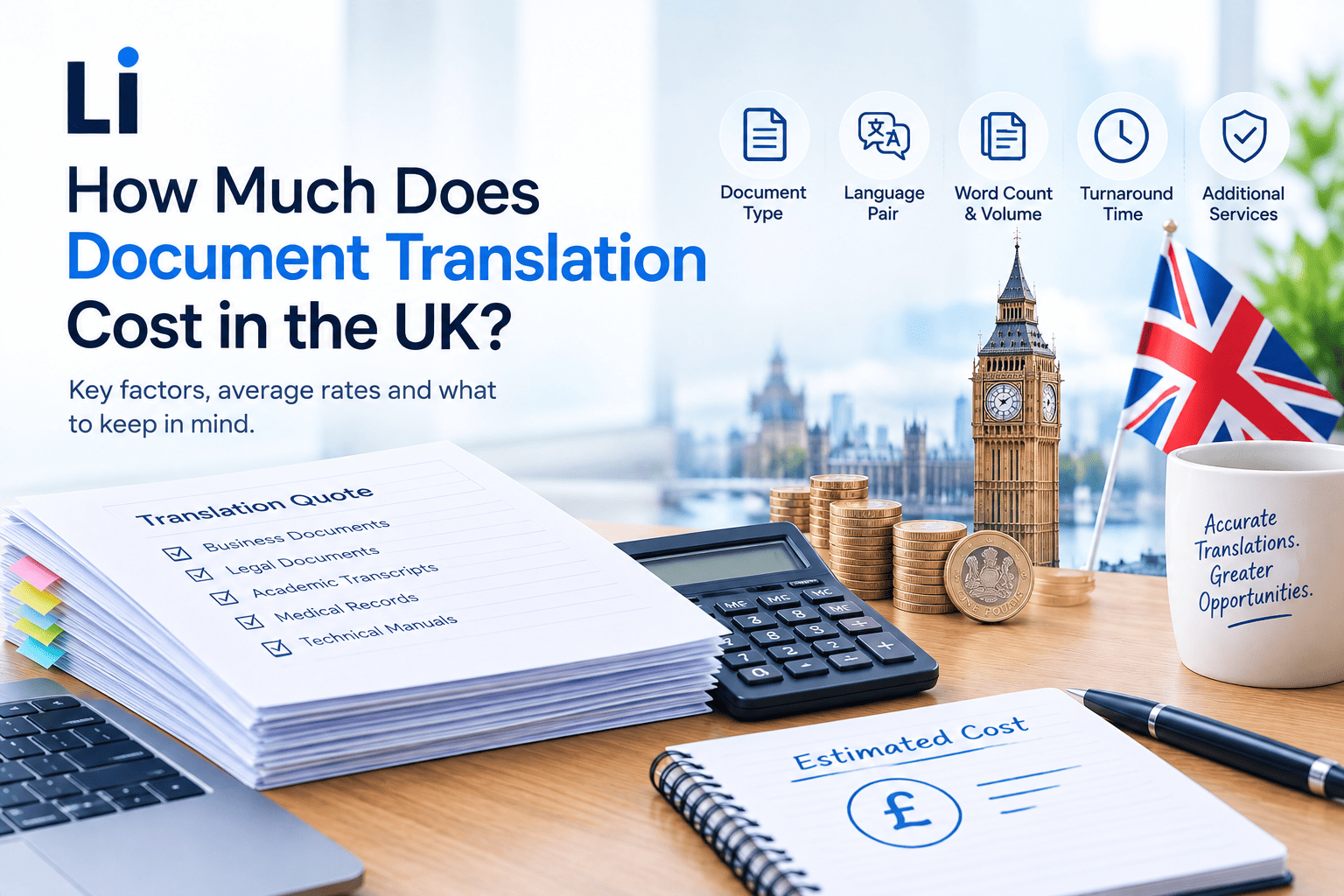
Thats why document translation cost UK varies from one project to another. The final price depends on the language pair, word count, document complexity, file condition, review requirements, urgency and certification. Understanding these factors makes it easier for businesses and individuals to compare quotations and choose the right provider.
What Does Document Translation Cost in the UK?
There isn’t a standard UK price because the cost to translate documents depends on the document itself and the services required. Most providers calculate document translation pricing using per-word, per-page, fixed-document or project-based methods.
The most reliable way to estimate the total cost is to have your files assessed before requesting a quotation.
How Is Document Translation Pricing Calculated?
Per-Word Pricing
Longer editable documents such as reports, contracts, manuals and website content are commonly priced using the source-language word count. This translation cost per word approach reflects the amount of content requiring translation and review.
Per-Page or Fixed-Document Pricing
Short certificates, forms and official records are often quoted per page or as fixed documents. However, a handwritten certificate or a page containing dense tables may require considerably more work than a standard typed page.
Project-Based Pricing
Large multilingual or mixed-format projects are often priced as one defined project covering translation, independent review, formatting and project management. This gives clients one clear scope instead of several separate charges.
What Factors Affect the Final Translation Cost?
Language Pair and Linguist Availability
Common language combinations often have a wider pool of qualified linguists, while less common languages or projects requiring specialist legal, medical or technical expertise may need additional resources. Choosing the lowest-priced translator isn’t always the best option for high-risk content.
Subject Matter and Risk Level
A company newsletter doesn’t require the same level of review as a court document or regulatory submission. Legal agreements, financial reports and technical manuals often require specialist subject knowledge, careful terminology checks and additional review. These requirements can affect both the price and delivery schedule.
File Format and Layout Work
Editable Word, Excel and PowerPoint files are generally easier to process than scanned PDFs, handwritten documents or complex design files. Transcription, desktop publishing and layout recreation can all increase the professional translation cost because they involve work beyond the translation itself.
Review, Certification and Urgency
Independent revision, proofreading, certification, notarisation, apostille support and physical delivery may all affect the final price. Urgent projects can also require reserved linguists, additional coordination or phased review to meet tight deadlines.
Do Minimum Fees Apply to Short Documents?
Yes. Even a short document requires project setup, linguist allocation, communication, quality checks and delivery. A 50-word certificate may therefore cost more than 50 words multiplied by the standard per-word rate.
When comparing quotations, check whether certification, VAT, postage and administrative work are included rather than focusing only on the headline price.
For example, a short certified document may require the same project setup and quality checks as a longer file, which can affect the final price.
How Multiple Languages and Large Volumes Affect Pricing
Adding more target languages increases translation, review and coordination requirements. Bulk pricing isn’t automatic. Any efficiency should reflect genuine repetitions, the total project volume and the agreed delivery schedule.
Translation memories and approved terminology may reduce repeated work. However, incomplete or poorly organised file sets can create additional project-management and review costs.
What Information Is Needed for an Accurate Quote?
For an accurate document translation quote, provide the complete source files, source and target languages, intended use and required delivery date. Send editable files where possible and identify any scans, images, tables or layout requirements.
Also confirm whether certification, notarisation, apostille support or specialist review is needed. For multiple files, include the priorities, correct versions and any phased-delivery requirements.
Providing the final version of the document helps avoid revised quotations caused by missing pages, updated files or additional formatting requirements.
How LingArch Helps Clients Understand Translation Costs
File Assessment Before Pricing
LingArch reviews every project by assessing the document type, word count, language combination, complexity, format and deadline. Any additional work, including certification or layout recreation, is identified before the scope is confirmed.
One Defined Project Quote
After reviewing the files, LingArch can prepare a defined quote for the agreed workflow. LingArch’s document translation services support businesses and individuals with structured workflows based on document type, language requirements and delivery needs.
Translation-memory analysis and phased delivery can also be considered for larger or recurring projects.
Relevant Quality Standards
As a trusted document translation agency, LingArch supports projects in more than 120 languages through a network of over 1,500 linguists. Its published quality framework references ISO 17100 for translation-service processes, ISO 9001 for quality management and ISO/IEC 27001 for information-security management.
Document Translation Pricing in Practice
One LingArch project involved a 60-page sustainability report translated into German, Spanish and Russian. For work of this kind, project-based pricing accounts for specialist linguists, editing, proofreading, client review, typesetting and a strict publication deadline.
Compare the Full Translation Scope, Not Just the Rate
The lowest price doesn’t always represent the best value. Language pair, word count, complexity, formatting, review, urgency and certification all influence the final document translation cost UK.
Submitting final, legible files together with your target languages, intended use and delivery deadline helps your provider prepare a more accurate quotation. Whether you need business documents translated across multiple languages or certified personal documents prepared for official submission, LingArch can review your files and provide a clear quote based on the language, complexity, format and deadline. Email [email protected], call +44 (0)208 004 7800 to discuss your translation requirements.
Frequently Asked Questions
1. Is document translation charged per word or per page?
It depends on the document type. Longer editable files are often priced per word, while certificates and forms may be quoted per page or as fixed documents.
2. Does urgent translation cost more?
It can. Urgent projects may require priority scheduling, additional coordination or reserved linguists to meet the deadline.
3. Can bulk translation reduce the cost?
Projects with repeated content may benefit from translation memories and efficient planning, but any savings depend on the files, delivery schedule and overall project scope.
4. What should a translation quote include?
A quotation should clearly explain translation, review, formatting, project management, certification, delivery, VAT and any additional charges so you understand the complete scope.